
This map tells the story of the Red River of the North and its recent flooding problems over the last few decades. To do this story telling, I used a bi-variate data scheme to show how the river valley has seen catastrophic flooding magnitudes and an increase in seasonal flooding magnitude over time. The width of the rivers measured for flooding magnitude are determined by the average of peak annual streamflow events from 1950 to 2008. The color of the stream shows how the decade-long running mean has changed from the 1950s to the new millennium. A closer look at the legend and how it works with the watershed hydrology can be seen on the image below. I also added a simple shaded relief inset map to help accentuate the watershed’s location and its flat topography. A few informational text boxes and a demonstration of flooding change at Grand Forks, North Dakota complete the description of this flood-impacted plain in America’s Breadbasket. This map combined a variety of my academic and personal interests, also netted for me a Best in Category Award at the 2010 Wisconsin Land Information Association’s annual meeting, which I am very grateful for!
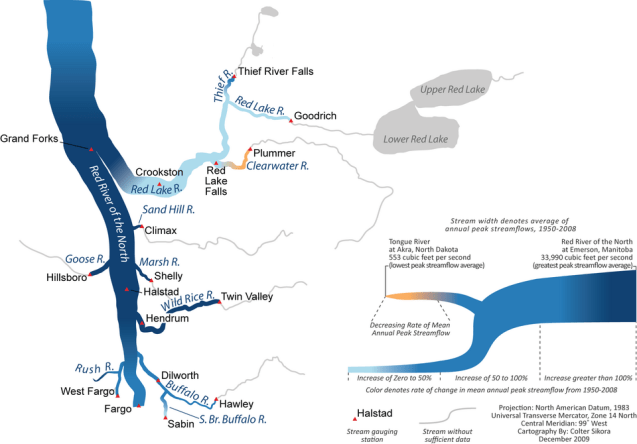
A portion of the Red River Valley with the legend at a closer scale. Note how much of the hydrology has seen an increase in mean annual peak streamflow. The only streams that do not see this change are relatively small tributaries.
 Colterrific Maps! (a portfolio)